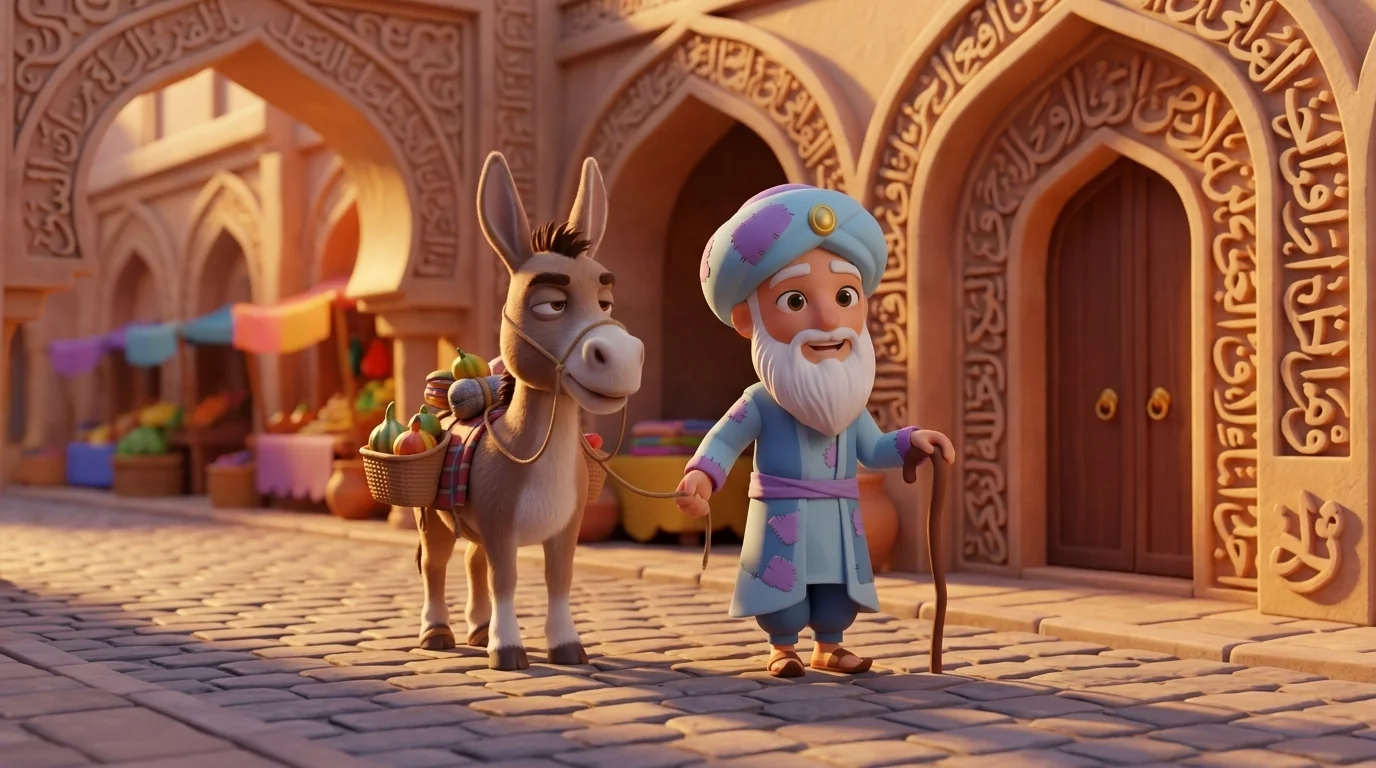
Origins of Juha
The Wise Fool
How a medieval trickster became the Arab world's most beloved character — and why he lives here, with us, at ArabyBuddy.
Juha — known as Nasreddin Hodja in Turkish, Djeha in North Africa, and Goha in Egypt — is one of the oldest and most widespread characters in world folklore. Scholars trace the earliest written stories to 13th-century Anatolia, though the tales almost certainly predate any manuscript.
His stories spread along trade routes, carried by merchants, travellers, and storytellers from Morocco to Central Asia. Every culture that adopted him gave him a local name and flavour — but the core never changed: a man who appears foolish but always has the last word.
Juha occupies a rare archetype — the fool who is wiser than the wise. His jokes are never random. Underneath the absurdity is always a pointed observation about power, greed, pride, or the gap between what people say and what they mean.
He rides his donkey backwards. He buries his money, announces it to his neighbour, then digs it up and moves it. He argues with judges and wins. He eats soup with a fork to annoy the man who paid for his coat. He is infuriating, delightful, and almost always right.
One of his classics
"A man came to Juha and said: 'My neighbour claims your donkey belongs to him.' Juha replied: 'Bring him here.' The man returned with the neighbour. Juha turned to the donkey and said: 'Tell him who your real owner is.' The donkey said nothing. Juha shrugged. 'You see? He's too embarrassed to take sides.'"
At ArabyBuddy, Juha is part of our cast — and we love him dearly. He brings exactly the energy Arabic learning needs: sharp wit, no fear of looking foolish, and a deep belief that wisdom hides in the most unexpected places.
When you meet him in a lesson, expect riddles, proverbs, and the occasional trap. He'll make you think. He usually wins. But he'll never make you feel small for getting it wrong — that's not his style.